
Guide to Underground Drill Rigs: Features, Benefits, and Applications
May 15, 2026
Underground mining is one of the toughest industrial environments in the world. Confined spaces, limited ventilation, hard rock, and constant production pressure all demand equipment built specifically for underground work.
At the centre of it all is the underground drilling machine. These rigs create the holes that drive mining and tunnelling forward, whether for tunnel development, production drilling, utility holes, or raise boring. Unlike surface rigs, they must work within strict size and safety limits, while still delivering reliable performance underground.
This guide covers what underground drill rigs are, how they work, their key features, and where they're used. It also looks at how KLR Universal supports underground mining with purpose-built rigs like the ITH-60 and KWD-10.
What is an Underground Drill Rig? Definition and Core Function
An underground drilling machine is a self-propelled or manually positioned rig, built specifically for underground mines, tunnels, and other confined spaces.
Unlike surface rigs, underground rigs must work within tight clearances. They're engineered to move through narrow drifts, portals, and passages, without losing drilling efficiency or safety.
The primary role of underground drill rigs is to drill:
- Blast holes for tunnel advancement
- Production rings in mining stopes
- Utility and drainage holes
- Rock bolting and support holes
Modern underground rigs must also work around limited ventilation. This has driven demand for low-emission diesel, electric, and battery-powered systems in underground mining.
The key performance indicators for a drilling machine underground include:
- Penetration rate
- Hole straightness
- Reliability
- Compact machine footprint
Key Features That Define Underground Drill Rigs
Compact and Low-Profile Design
Underground openings often have strict size limits. A rig that can't fit through a confined drift can't work underground at all.
Modern underground drilling machines therefore feature:
- Compact width and height
- Articulated chassis designs
- Tight turning radius
This allows rigs to manoeuvre through narrow underground spaces efficiently.
Hydraulic Power and Control
Most underground drilling equipment uses hydraulic systems to power drilling functions, boom movement, feed systems, and tramming.
Hydraulic systems provide:
- Smooth power delivery
- Precise drilling control
- Reduced mechanical complexity
- Better reliability in harsh underground conditions
Boom and Feed Geometry
The boom positions the drill steel at different angles on the rock face. The feed system controls drill advancement.
Underground operations require drilling at multiple orientations, including:
- Up-holes
- Down-holes
- Angled blast holes
Longer feed lengths reduce rod changes and improve productivity.
Dust and Fume Management
Dust and diesel emissions are major underground safety concerns.
To improve underground air quality, rigs often include:
- Wet flushing systems for dust suppression
- Tier 4 emission-compliant engines
- Electric or battery-powered alternatives
These features are now standard requirements in many underground mining projects.
Tramming and Mobility
Self-propelled underground drill rigs can move independently between drilling locations.
Common mobility systems include:
- Rubber-tyred tramming systems
- Crawler-mounted systems for rough conditions
Efficient tramming cuts wasted time and speeds up the drilling cycle.
Types of Underground Drill Rigs and Their Applications
Development Drill Rigs
Development rigs are used to drill blast rounds that advance underground tunnels and headings.
Typical characteristics:
- Fast drilling cycles
- Multi-hole face drilling capability
- High productivity requirements
These rigs commonly drill 24–64 holes per blast round.
Production Drill Rigs (Stoping Rigs)
Production or stoping rigs drill long production holes into ore bodies.
Applications include:
- Ore extraction drilling
- Long-hole stoping
- Upward production drilling
These rigs require a strong pull-back force and reliable feed systems.
ITH (In-the-Hole) Underground Rigs
ITH rigs use downhole hammer systems similar to surface DTH drilling.
Typical applications:
- Raise boring pilot holes
- Long production holes
- Drainage and dewatering holes
ITH rigs provide excellent hole straightness over long drilling distances.
Down-the-Hole Underground Rigs
DTH-equipped underground rigs are used for efficient hard rock drilling underground.
They are commonly used for:
- Development drilling
- Utility holes
- Medium-depth underground drilling
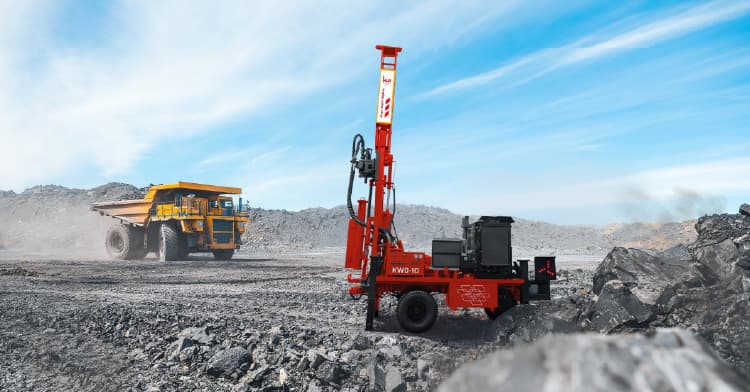
The KLR Universal KWD-10 uses the DTH method to achieve efficient penetration rates in hard rock underground environments.
| Underground Rig Type | Primary Application | Hole Depth Range |
|---|---|---|
| Development Rig | Tunnel advancement | 3–6 m per round |
| Production Rig | Ore production drilling | 10–50 m |
| ITH Underground Rig | Long holes and raises | 50–200 m+ |
| DTH Underground Rig | Hard rock drilling | Up to 30–100 m |
Benefits of Using Purpose-Built Underground Drill Rigs
Purpose-built underground drilling equipment offers significant operational advantages compared to adapted surface rigs.
Higher Productivity
Underground rigs are optimised for fast drill-and-blast cycles with:
- Faster penetration rates
- Reduced setup time
- Lower downtime
Improved Safety
Modern underground rigs incorporate:
- Safer operator positioning
- Dust suppression systems
- Better visibility and boom control
Better Accessibility
Compact underground rigs can reach confined headings and tight spaces that larger rigs simply can't.
Increased Reliability
Purpose-built rigs are designed for continuous underground operation with:
- Accessible maintenance points
- Standardised hydraulic systems
- Durable electronic controls
Lower Cost Per Metre
The upfront cost may be higher, but underground rigs usually cost less per metre drilled overall. Better efficiency and less downtime make up the difference.
What to Look for When Selecting Underground Drilling Equipment
Selecting the right underground drilling machine requires careful evaluation of site conditions and drilling requirements.
Key considerations include:
- Drift dimensions versus rig size
- Required hole depth and diameter
- Rock hardness and drilling method
- Diesel versus electric power systems
- Tramming speed and mobility requirements
- Manufacturer support and spare parts availability
- Automation and onboard diagnostics
Hard rock applications often favour DTH or ITH underground rigs, while varying formations may support top hammer drilling methods.
KLR Universal Underground Drill Rigs: The ITH-60 and KWD-10
KLR Universal is one of India's leading drilling rig manufacturers. Since 1984, the company has applied decades of drilling engineering expertise to underground mining applications.
The company’s underground rig range is designed for:
- Hard rock mining conditions
- Confined underground environments
- Demanding drilling cycles
ITH-60: In-the-Hole Underground Drill Rig
The ITH-60 uses the ITH drilling method for direct energy transfer to the bit.
Applications include:
- Long production holes
- Raise boring pilot holes
- Drainage and dewatering holes
Its key advantage is excellent hole straightness over long drilling distances.
KWD-10: DTH Underground Drill Rig
The KWD-10 is a compact DTH underground drilling machine designed for efficient drilling in confined spaces.
Typical applications:
- Development drilling
- Utility holes
- Medium-depth hard rock drilling
The DTH system provides strong penetration rates while maintaining a compact machine footprint.
Conclusion
Underground drill rigs are highly specialised machines, built for the specific challenges of underground mining and tunnelling. Their compact size, hydraulic controls, and advanced drilling capabilities set them apart from surface rigs.
Choosing the right underground drilling equipment directly affects productivity, safety, and efficiency. Key factors to weigh include drift dimensions, rock hardness, drilling depth, mobility, and manufacturer support.
For mining engineers, contractors, and procurement teams evaluating drilling solutions, KLR Universal offers purpose-built underground drill rigs like the ITH-60 and KWD-10, designed to meet the demands of modern underground operations.